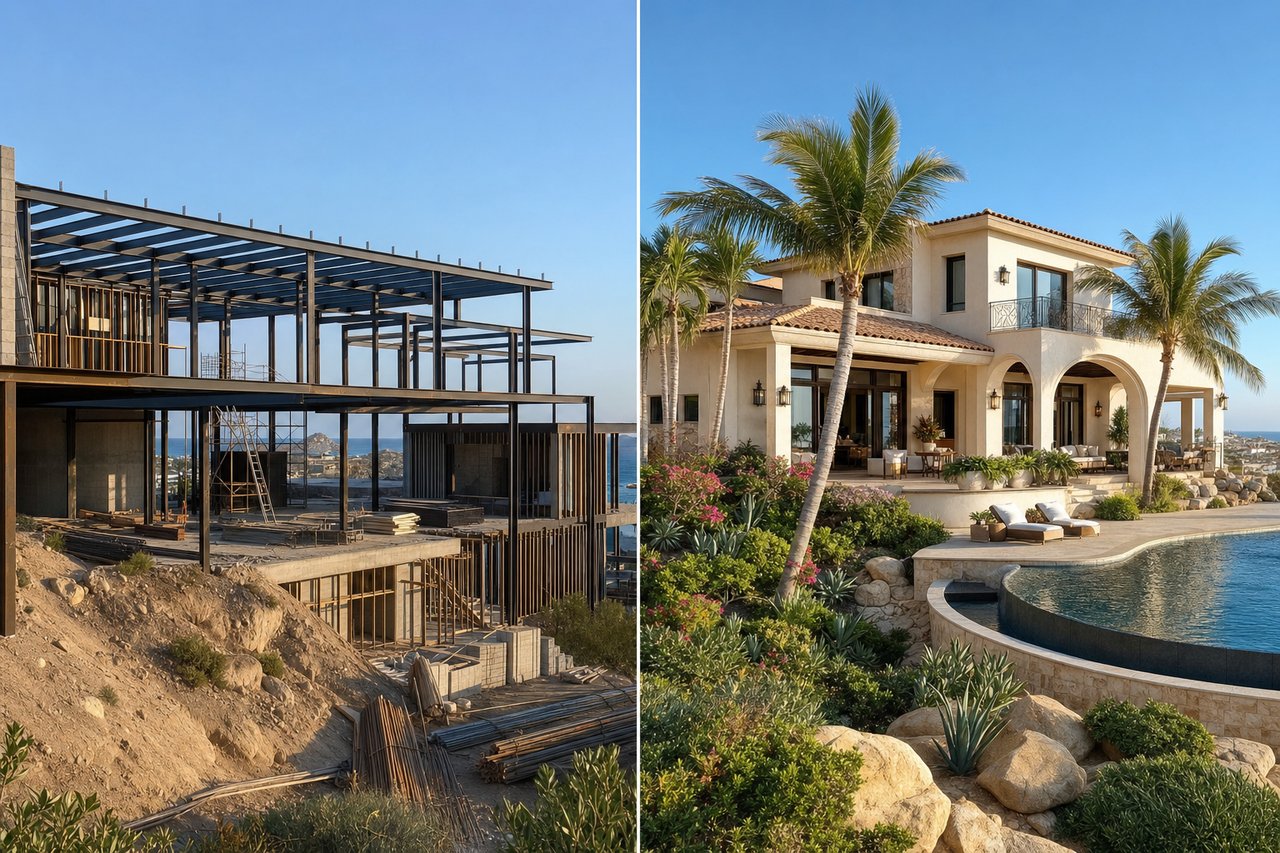
Pre-Construction vs. Resale in Cabo: The Honest Comparison Every Luxury Buyer Needs
By Joe Taylor | Updated May 2026
Roughly half the luxury buyers I work with arrive thinking they know whether they want pre-construction or resale. Most of them change their mind by the end of the search. The decision is more nuanced than the standard "new vs. used" framing suggests, and it has more to do with your tolerance for execution risk, your timeline, and your specific use case than with any universal "better" answer.
This post is the honest comparison. What pre-construction wins on. What resale wins on. The risks unique to each. And the decision framework I use with buyers when they ask which is right for them.
What pre-construction actually means in Cabo
In Cabo, "pre-construction" covers a range of project stages:
· Concept/launch phase: Developer is taking reservations on a project that's not yet under construction. Highest discount, highest risk, longest wait.
· Active construction: Project is breaking ground or under construction. Some discount remaining, moderate risk, 12–24 month wait.
· Late construction: Project is months from delivery. Smaller discount, lower risk, short wait.
· Just-delivered: Technically resale once recorded, but functionally a brand-new unit.
The economics and risk profile vary significantly across these stages. When buyers say "pre-construction," I push to clarify which stage they're considering.
What pre-construction wins on
1. Price entry below eventual market value
Developer pricing in the concept and active construction phases typically runs 15%–25% below the eventual market value at delivery. The developer is incentivized to fill the project with committed buyers early to fund construction, so they discount aggressively in exchange for buyers taking timing and execution risk.
On a $2M unit, that's $300K–$500K of paper value at delivery. If you hold through delivery and rent or sell post-delivery, the appreciation pickup is real. The discount narrows as the project progresses — buying in late construction often captures only a 5%–10% discount.
2. Customization
Buying pre-construction usually means you can select finishes — flooring, cabinetry, countertops, fixtures, sometimes layouts. The customization window varies by developer and how early you sign, but in the concept phase you can often influence floor plans materially.
For luxury buyers who care about details, this is meaningful. You walk into a finished home that reflects your specific taste, not the previous owner's.
3. Payment plan
Pre-construction typically requires 20%–30% upfront with the balance due at delivery. This is significantly easier on capital allocation than a cash resale purchase that requires 100% at closing. For buyers managing portfolio liquidity, the staged payment is a structural advantage.
4. Modern construction standards
New construction in 2026 reflects current building codes, hurricane resistance standards, energy efficiency requirements, and contemporary design preferences. Older Cabo luxury inventory built in the 1990s and 2000s often needs significant upgrades to match modern standards.
5. Brand new condition
No deferred maintenance, no surface wear, no decade-old HVAC systems on borrowed time. A new property in 2026 should run 8–12 years before requiring meaningful capex investment.
What pre-construction loses on
1. Developer execution risk
This is the single biggest risk in pre-construction buying. The developer takes your deposit, breaks ground, runs into capital constraints, schedule delays, contractor disputes, or outright project failure — and your timeline stretches, your capital is locked up, and in worst cases your project never delivers.
Cabo has seen multiple high-profile project delays and outright failures in recent years. The pattern: aggressive sales velocity in the launch phase, escalating delays through construction, communication breakdowns with buyers, and either eventual delivery 2–4 years late or partial refunds in negotiated workouts.
Defense: Only buy pre-construction from developers with at least 3 completed comparable projects. Ask for references from buyers who took delivery on prior projects. Avoid first-time developers, especially in the concept phase.
2. 2–3 year wait before use or rental income
Pre-construction at the concept phase typically delivers 2–3 years after you commit. During that period, no personal use, no rental income, and you're carrying the deposit (20%–30% of purchase price) with no offsetting return.
If your investment thesis depends on rental income starting soon, pre-construction is the wrong choice at the concept phase. Late-construction projects (months from delivery) work better for buyers who want rental income soon.
3. Market risk during construction
If the Cabo market softens during your build window, you can't easily sell to escape. Most pre-construction contracts have steep penalties for buyer cancellation, and assignment (selling your contract to another buyer pre-delivery) is often restricted by the developer.
You're committed. If the market drops 10% during your build, you take that hit on paper — though most pre-construction buyers hold through and let appreciation recover over time.
4. Specification creep
The renderings show $400/sf finishes. The promised finishes get value-engineered down during construction to $250/sf finishes. The promised landscaping is reduced. The promised pool size shrinks 10%. The promised hardwood becomes engineered wood.
This is a constant pattern in pre-construction across many luxury markets. Cabo is no exception. The defense: lock specifications in writing, with exhibit lists of specific products and brands, and inspect rigorously at delivery.
5. No track record of HOA or community function
A brand-new project doesn't have years of HOA financial history, special assessment history, or rental performance data. You're betting on the operating model the developer projects, not on actual operating data.
What resale wins on
1. You see exactly what you're getting
Walk-through, inspect, evaluate. No spec drift, no value engineering, no surprises at delivery. The kitchen you see is the kitchen you get. The pool you see is the pool you get.
For luxury buyers, this certainty is valuable. The difference between renderings and reality is real, and resale eliminates the gap.
2. Immediate use and rental income
You close, you have keys, you can use the property next week, and you can list it for rental the week after. Cash flow from day one — no 2–3 year wait.
For buyers underwriting a purchase with rental income as part of the thesis, this is a major structural advantage.
3. Negotiating leverage
Especially in 2026's buyer's market. Resale sellers are individuals, not corporate developers. They have life circumstances that motivate them — relocations, divorces, estate situations, retirement moves. Skilled negotiation regularly captures 5%–12% off list on resale luxury inventory.
Pre-construction prices, by contrast, are set by the developer with relatively little negotiation room. You might get a few minor incentives (closing credits, upgrade allowances) but rarely material price reductions.
4. Established HOA financials
You can audit 3 years of HOA financials, reserve fund balance, assessment history, and meeting minutes. You know exactly what the community costs to operate and what the financial health looks like.
This due diligence is impossible on a new project because the data doesn't exist yet.
5. Established rental performance
If the property has been rented for 3+ years, you have real bookings data, real ADRs, real occupancy. You can underwrite the rental income with actual performance rather than developer projections.
In Cabo, developer rental projections in the launch phase are consistently optimistic. Resale gives you ground truth.
6. Mature landscaping and community character
Years of growth on tropical plantings. Established architectural character. Mature trees that frame views and create privacy. New construction starts with 3-gallon plants and looks the part for the first 5+ years.
For some buyers this matters a lot. For others, not at all.
What resale loses on
1. Deferred maintenance
Even immaculate-looking resale properties have wear. AC systems aging out. Pool equipment due for replacement. Roof at the end of its useful life. Hardware fading from sun exposure. The closer to a 15+ year old property, the more capex you should budget — typically 1%–2% of property value annually.
Defense: Quality property inspection by a Cabo-experienced inspector. Budget 1%–2%/year of property value for maintenance reserve.
2. Older finishes
Many resale luxury homes need a finish refresh after 7–10 years. Kitchens, bathrooms, flooring, paint, fixtures. A "great property with dated finishes" often needs $100K–$300K of investment to compete with modern construction on rental performance.
If the price reflects the dated condition, this is fine and often even advantageous (you control the refresh and can spec it precisely). If the price is at market for fully updated inventory but the finishes are dated, you're overpaying.
3. Pre-2010 construction may not meet current hurricane standards
Cabo's modern building code reflects lessons learned from Hurricane Odile (2014) and subsequent storms. Properties built before 2010 may have less robust hurricane resistance — window glazing, roof tie-downs, structural engineering. Not necessarily a deal-breaker, but factor it into inspection and insurance.
The decision framework
Here's the framework I use with buyers:
Choose pre-construction if:
· The discount to projected market value is significant (15%+) and the developer track record supports believing in it
· The 2–3 year wait fits your timeline
· You want customization in the finishes
· You're confident in the developer's execution
· The HOA structure is well-documented even if not yet operating
· You can carry the capital commitment without rental income offsetting
Choose resale if:
· You want immediate use or rental income
· You want certainty about the property's actual condition and character
· You want negotiating leverage (especially in a buyer's market like 2026)
· You want established HOA and rental performance data
· You prefer mature landscaping and established community character
· The available resale inventory matches your specific needs
My personal take for 2026
In the 2026 Cabo market, resale has the edge for most luxury buyers. Inventory is high. Sellers are negotiable. Days on market are long. You can find excellent resale properties at 5%–12% below recent comps with strong rental track records and established HOA structures.
Pre-construction makes sense in three specific scenarios:
1. Top-tier branded developments — Four Seasons Residences, Ritz-Carlton Residences, SLS Residences, Waldorf Astoria Residences, Montage Residences. The brand carries appreciation, and developer execution risk is materially lower because brand operators don't tolerate execution failures.
2. You want a specific layout that doesn't exist in resale — large family compound, single-level luxury, specific orientation. Sometimes the inventory you want only exists in pre-construction.
3. You're a sophisticated investor allocating capital across multiple properties — staged payment structure helps you deploy capital across more positions than cash-resale would allow.
For the typical luxury second-home buyer in 2026, resale is the better risk-adjusted choice. Pre-construction is the smarter choice in specific situations.
Due diligence for pre-construction specifically
If you're going pre-construction, the due diligence list is different from resale:
Developer due diligence:
· 3+ completed comparable projects with delivered units
· References from prior-project buyers willing to talk
· Financial stability of the developer entity
· Construction lender involved (a major bank lending suggests vetting)
· Track record of on-time delivery
· Track record of finish-spec adherence
Project due diligence:
· Detailed specification list, item by item, with brand names and quality grades
· Floor plan, finish, and amenity exhibits attached to the contract
· Construction timeline with milestone definitions
· Penalty structure for developer delays (your protection)
· Penalty structure for buyer cancellation (their protection)
· HOA structure and projected operating budget
· Pre-construction deposit protection (escrow, not direct to developer)
Contractual due diligence:
· Independent Mexican attorney reviews the contract
· Clear assignability terms if you ever need to exit
· Walk-through and acceptance process at delivery
· Punch-list and warranty provisions
The bar on pre-construction due diligence is meaningfully higher than on resale due diligence. The risk profile is higher, so the analysis needs to be deeper.
The bottom line
Pre-construction vs. resale isn't a universal "better" decision — it's a fit-for-purpose decision. The 2026 Cabo market favors resale for most luxury buyers because of negotiating leverage and certainty. Pre-construction wins in specific scenarios with specific developers and specific project profiles.
If you want me to evaluate a specific pre-construction project or compare it against resale alternatives in the same community, that's exactly the kind of analysis I do regularly. Reach out and I'll put together a side-by-side.
Joe Taylor
JoeSellsCabo.com
(916) 756-9145
